 MapEmbed SkyDoorMobile versionFacebook pageFeedback
Photos Royal Citadel
Information Royal Citadel
The royal Citadel of Hue complex has
the characteristic of many strongholds
and fortresses. Gia Long Emperor had it
constructed in 1804, originally in
earth, but additionally covered in brick
later in the early 19th century.
Surrounded by a wide zigzag moat, the first layer of the royal Citadel is the defensive wall fort of 10 kilometer long, 7 meters high and 21 meters thick. The fort itself has 10 gates for pedestrians and 2 gates for water routes. Within, it also encompasses two other monarchal areas. The Imperial Enclosure, or Dai Noi, is encircled within a wall of 2.5 km long and 6 m wide. The Forbidden Purple City, within a perimeter of 1.3 km, was the reserved place for the private life of the kings and the royal members only.
Inside the complex, there is also a large cluster of smaller constructions. All of them lie around the main axis of the complex, running from north to south. Beginning with the northernmost Flag Tower, followed by the Ngo Mon (Noon) Gate, which was only reserved as a path only for the royal, and some others that show significant architectural value. Entering the Ngo Mon Gate, one will see the Belvedere of Five Phoenixes, also constructed by Emperor Gia Long in 1823 as a pavilion to list the names of successful scholars in the past. Another remarkable building is Thai Hoa Palace or the Palace of Supreme Harmony, built 1833, and used as the reception hall and the throne room of the emperor.
The main entry
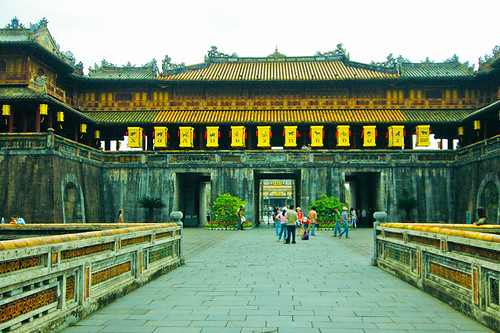
The royal Citadel of Hue complex has the characteristic of many strongholds and fortresses.
Surrounded by a wide zigzag moat, the first layer of the royal Citadel
is the defensive wall fort of 10 kilometer long, 4 meters high and 21
meters thick. The fort itself has 10 gates for pedestrians and 2 gates
for water routes. There are 24 towers on top of the citadel are surrounded by a deep moat system named Ho Thanh. The moat has an average width of 35m and a length of 7km to protect the imperial citadel.
Following alterations to the overall plan for the Imperial City the Ngo Môn Gate was built between 1833 and 1840. It became one of the main entrances to the Imperial City of Hué. Restoration work carried out with Japanese financial assistance was completed towards the end of 1993.
Ngo Mon (Noon) Gate
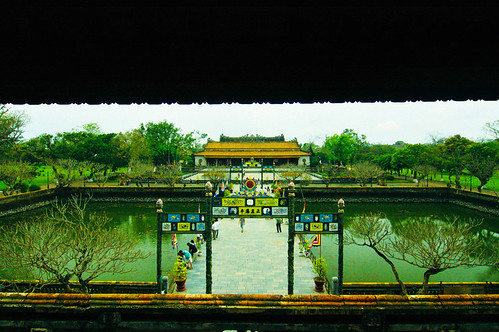
The Ngo Mon (Noon) Gate, which was only reserved as a path only for the royal, and some others that show significant architectural value.
Flag Tower
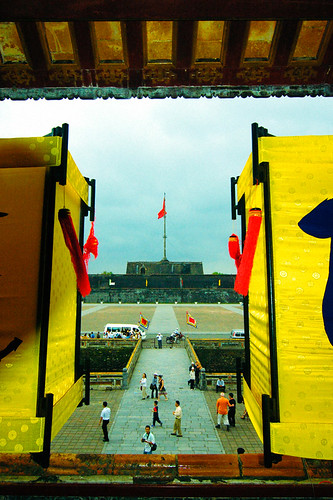
Standing right in front of the Ngo Mon (Noon) Gate on the south, the Flag Tower (Cot Co) is also part or the royal Citadel. The 37m-high tower, also known as the King’s Knight, is Vietnam’s tallest flagpole, erected in 1809 and almost completely destroyed in 1947. It was erected again in 1949 in its present form of three tiers, representing the natural order of earth, human beings and heaven.
Forbidden Purple City
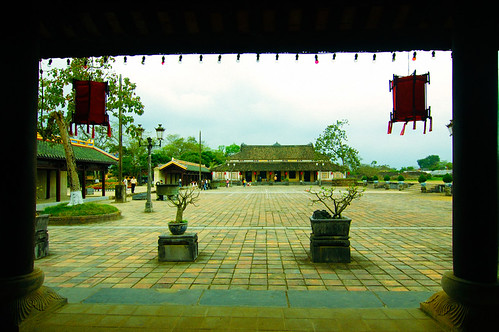
The Forbidden Purple City, within a perimeter of 1.3 km, was the reserved place for the private life of the kings and the royal members only.
Imperial Theatre
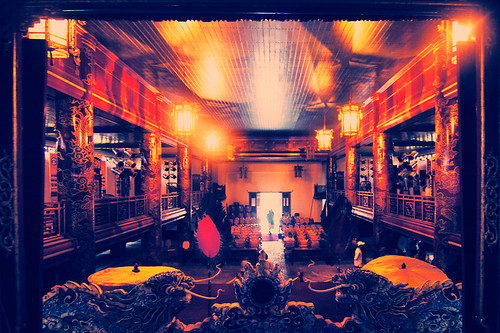
Located in the eastern part of the Forbidden Purple City, the theatre was built in 1826 and then reconstructed in 1945. In 1962 it became the Hué conservatoire of music.
Complex of the Temple for the Worship of the Nguyen Emperors
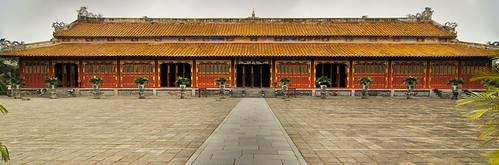
This complex, located to the south-east of the Imperial City, comprises:
- the temple itself (Thé Mieu) built in 1820;
- the Temple of the Resurrection (Hung Mieu), dedicated to the worship of the father of Emperor Gia Long (1802-1820);
- the multi-storey Pavilion of Radiant Benevolence from On-High (Hiern Lam Cac);
- the nine bronze dynastic urns, cast between 1835 and 1839, each weighing two and a half tonnes;
- the surrounding walls and twelve gateways through them.
Nine Urnes Dynastiques
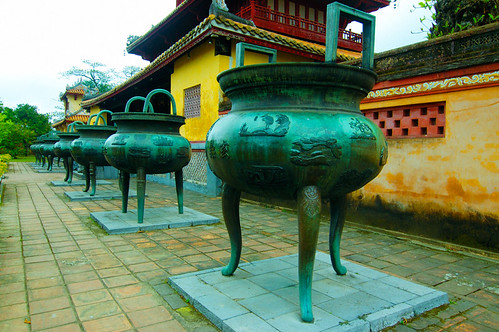
Each of the Nine Dynastic Urns has a different name. Although they all look equal, each has a unique form. They were cast between 1835 and 1837. They weight from 50,000 ounces to almost 100,000 ounces (1,600-2,600 Kg).
Each of the urns represents a different Nguyen king. The urns are decorated with typical Vietnamese motifs (the sun, the moon, mountains, rivers and landscapes). The names of the urns are Cao, Nhan, Chuong, Anh, Nghi, Than, Tuyen, Du, and Huyen.
Source: http://www.flickr.com/photos/npav/
| Post to FacebookPost to Twitter | Embed this place into your site |


