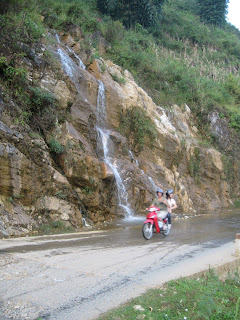
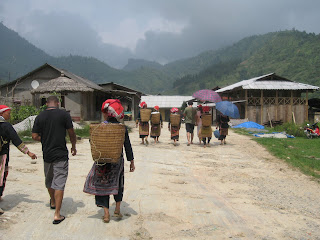
(Ryan shared his trip to Sapa with motorbike, where he went, what he saw in the magnificent landscape)
Sapa is a pretty town in the mountains of northwestern Vietnam near the Chinese boarder.
Originally built by the French as a medical outpost, the city is now
full of minority people from the local mountains and one of the major
tourist destinations of north Vietnam. On Friday, 19 September, Ben,
his girlfriend Huyen, Ben’s college friend Paul, and I set out for
Sapa. The first leg of the journey began on a night train to the
boarder town of Lao Cai. We arrived in Lao Cai early Saturday morning
and hired a shuttle to Sapa. Thanks to the infusion of tourist dollars
and French planning, Sapa is a very pretty and well-designed town. The
town sits on a saddle and overlooks two large valleys. Vietnam’s
largest peaks surround the town, and these are rugged mountains with
significant elevation changes. Vietnam’s tallest peak, Fansipan, is
very close.
Ethnic people, Sapa
The first thing we did after checking into our hotel Sapa GoldSea was rent motorbikes.
We rented three Honda Waves: one for me, one for Paul, and one for Ben
and Huyen. Paul, who’s an actor from LA, had never ridden a motorbike
before. We weren’t on the bikes for even two minutes before Paul drove
his motorbike directly into the largest curb in Sapa. Apparently he was
having difficulty turning and braking. Luckily Paul wasn’t hurt, even
though I was convinced that he was going to fly over the handlebars,
across the sidewalk, and into the bushes. Ben and Huyen were already
back at the hotel wondering were Paul and I were as 12 or 15 Vietnamese
men surrounded us and shook their heads, saying to Paul, “you no drive
motorbike good.” The damage: the front tire was bent pretty badly. The
total cost of the damage: 400,000 VND, roughly 25 USD. While his bike
was at the shop, Paul hopped on the back of my bike and we left Sapa to
visit some of the minority villages nearby. And Paul and I discussed
how to drive a motorbike, which lead him to some success later in the
trip.
Motorbike trip
The first village we came to was remarkable only because a sixty-foot
section of the road through the village was comprised of one continuous
rock. We parked our motorbikes and started walking through the town,
but quickly realized that we weren’t going to see much because each of
us had three minority (H’mong, I think) women surrounding us saying, “You buy from me? Very cheap for you—good price.”
We retreated to our motorbikes and did a bit of shopping for hand woven
textiles and silver jewelry, then took the road through town to the
cave in the mountain.
Outside the cave stood six young boys
carrying flashlights. After haggling with the boys, we rented four
flashlights for 10,000 VND each and hired one of them to guide us
through the cave. We had been hiking into the cave for 20 or 30 minutes
when we made a startling discovery: This was a cave to China. Our guide
told us that if you knew the way and had two or three days, the cave
would dump you out in China. Needless to say, Ben, Paul, and I were
ecstatic. A real tunnel to China? Amazing!
Local souvenirs on sale
We left the cave and returned to our motorbikes to find them flocked
with more minority women, again trying to sell us things. One of them
lived a short distance from the cave’s entrance and she invited us back
to her house. We accepted. The house was a barn, except that people
lived there too.
She kept pigs just outside the back door.
We asked to see them and she proceeded to feed them corn. There were 12
or 15 pigs, mostly piglets, a few medium sized pigs, and a few big
mommas. I asked Huyen, our official interpreter, what a pig costs in
the local market. A big pig, one used for breeding, cost 50,000 VND, or
roughly 3 USD. A medium sized pig, the best for eating, cost 80,000
VND, or roughly 5 USD. I suggested we buy an eating pig and hire the
women to cook us lunch, but between Paul’s protests and the realization
that they wouldn’t cook for us, we headed back to Sapa pigless.
Buffalo in Sapa
That afternoon we picked up Paul’s bike and headed into one of the
valleys below Sapa. There we visited the ancient stone carvings. There
not actually stone carvings, but some black rocks (basalt maybe) that
poke up like sea monsters among the terraced rice fields. The scenery
was beautiful. It was rice harvest time, so the rice field were light
brown instead of rich green. To harvest rice, the locals cut the rice
grass and lay it in bundles to dry. Once sufficiently dry, the bundles
are beaten over bamboo baskets to knock the rice grains out. The rice
grain is stuffed into huge sacks for transport to a machine that
removes the husk from the grain. At this point the rice is ready for
the market. The whole process relies heavily on manual labor, sickles,
and water buffaloes.
Cute children in Sapa
We came back the hotel after an interesting trip day. Having dinner at The Golden Restaurant, we had a happy time to relax.
Further information about Adventure tours, you can visit: